Sunday, March 10, 2024

Indian Poetics and Aesthetics


Indian Poetics and Aesthetics 


Hello readers,


This blog is based on Thinking activity which is assigned by Dr. Dilip Barad sir.


In ancient India, Sanskrit was the language of literary criticism, known as Sahityasastra. It encompassed various aspects like Alamkarshastra, Kavyashastra, and Kavyamimansa, all aimed at understanding poetry's purpose of evoking pleasure (Rasanubhuti).

Indian poetics, especially Sanskrit poetics, laid the groundwork for literary analysis. Concepts like Rasa, Vakrokti, Alamkara, Auchitya, and Riti emerged, offering deep insights into literature.

Criticism in Indian poetics widened perspectives on artworks since language is limited in expressing experiences. Simplifying complex ideas, Indian poetics classified various aspects, enhancing our understanding of literature.

It is devided in many catagories:

1. Rasa theory by Bharata
2. Dhvani theory by Aanandvardhan
3. Vakrokti theory by Kuntaka
4. Alamkara theory by Bhamaha
5. Riti by Vaman
6. Auchitya theory by Kshemendra.


Rasa theory by Bharata


Bharata refers to the human soul as Bhava-Jagat, translating to "the world of emotions." He extensively explored the theory of Rasa, which holds significant importance in both concept and context. Rasa is instrumental in creating a delightful atmosphere around feelings and emotions, drawing inspiration from the references found in the Upanishads. Through his work, Bharata delved into the diverse expressions within the realm of human experience, shaping our understanding of the intricate interplay between emotions and the world around us.

The theory of rasa is expounded in Chapter 6 of the Natya Shastra, an ancient Sanskrit text ascribed to Bharata Muni. Bramha's Srirti(world) is of Shad Rasa. (6 rasa)
ભાવનું ઉર્ધ્વીકરણ એટલે રસની પ્રાપ્તિ.

विभावानुभावव्यभिचारिसंयोगाद्ररस निष्पत्ति:।

"Rasa is produced from a combination of Determinants(Vibhava), Consequents(Anubhava) and Transitory States(Vyabhicharibhava)."

According to Sahitya Darpan, Sthayi Bhavas intertwine with Vibhav, Anubhav, and Vyabhicharibhav to evoke Rasa. These Sthayi Bhavas serve as the foundation, leading us to Sanchari Bhavas, of which there are 33 kinds, akin to the fleeting tides of the ocean, reflecting facial emotions or Mukhavaivarnya.

Satvik Bhavas, though often imperceptible, play a crucial role. For instance, in Kumarasambhav, when Narad conveyed Shiva's proposal to Parvati, her drooping eyelids exemplified Satvik Bhavas.

The line "બીજ માંથી પૂનમ દઈ દે સહેજ પાપં નમેલી ખોલી નાખ" by Manoj Khanderiya also exemplifies Satvik Bhavas, portraying subtle yet profound emotions.

Sthayi Bhavas : 

Bharat in Natyashastra describes eight rasas. Later on Abinavgupta add one more rasa namely "shanta" in it. 

"श्रृंगार करुण वीर

        रौद्र हास्य भयानका।

बिभत्सादभूत शांतश्व

         नव नाट्ये रसा: स्मृता ।।"


Table of Rasa :


Vibhav : 

Rasa emerges through the interaction between characters or elements within a narrative. For instance, in Abhijnanasakuntalam, the relationship between Dushyant and Shakuntala exemplifies Alambana Vibhava or Uddipana Vibhava. Similarly, in the story of Romeo and Juliet, they serve as Vibhava-Excitants, driving the emotional dynamics of the narrative.


Anubhav :

Places like the Tamala tree where Dushyant and Shakuntala met, the oak tree, and the garden in Romeo and Juliet serve as examples of Anubhav. However, Khemi by Ra. Vi. Pathak stands out as an exception in Anubhav because, for the arousal of Shringara Rasa, there needs to be a Yathochit or proper atmosphere. Another illustration is the Gujarati movie "Karsandas - Pay and Use."


Vybhichari Bhav :

Anubhav is akin to Sanchari Bhavas, representing transitory feelings born out of emotions themselves. For instance, depression can stem from sorrow. At times, these feelings are intertwined with more than one emotion; for instance, sickness, despair, and remorse may arise from sorrow.


Samyog :

The poet must synchronize elements in such a way that they seamlessly blend, much like sugar melting in milk, where they become indistinguishable from each other.


Dhvani school


Dhvani school of poetry was originated by Anandavardhana. He wrote “Dhvanyaloka” in the middle of the 19thcentury which brought focus on the potential power of the word in Kavya.Anandvardhana in Dhvanyalokam takes up three main types of implicit sese: Vastudhvani, Alankaradhvani and Rasa dhvani.

Next only to the rasa theory in importance, the dhvani theory of anandavardhana considers suggestion, the indirectly evoked meaning as the characteristic property of literary discourse, the determinant that separates it from other rational discourses. Dhvani becomes an embracing principle that explains the structure and function of the other major elements of literature- the aesthetic effect (rasa), the figural mode and devices (alamkara), the stylistic values (riti) and excellences and defects (guna-dosa).


In Dhvayyaloka, Ana presented a structural analysis of indirect literary meaning. He has classified different kinds of suggestion and defined them by identifying the nature of suggestion in each. According to V. S. SeturamnDhavani means "That kind of poetry, where in the meaning renders itself secondary or the word renders its meaning secondary and suggests the implied meaning is designated by the learned as 'Dhavani' or 'suggestive poetry'.


Riti School


              Riti is the theory of language of literature. The word Riti was first used by Bharata'sNatyasastra' itself under the republic of vrtti. But it was Vamana who first developed it into a theory of VisistaPadaracanariti'. In the very simple words formation of or arrangement of marked constructions is riti.


Two other words are used for riti are Marga and Vrtti. Later, around ninth century AD Anandavardhana distinguished this styles on the basis of the use of particular kinds of compounds. The Gunas have their potential being in this permanent source which Vamana regarded as the Atman of the Kavya and called it Riti. Hence the thesis "Riti is the Soul of a Kavya." 'RitiroatmaaKaavyasyaSareerasyeva'. Riti is to the Kavya what Atman is to the Sarira. It is necessary here to study the etymology of the terms Atman and Riti in order to realise the significance of Vamana's conception of the Soul of a Kavya. The word Atman is believed to have been derived from the root 'At meaning to move constantly or from the root Anmeaning to live, or perhaps from both.


The term Riti is derived from the root 'Ri' meaning to move. The identity of Riti with Atman | becomes complete when we take Dandin's metaphor of Gunas as Pranas. Just as the Atman is the Karana Sarira of a person, Riti is the Karana Sarira of a Kavya. The natural beauty or Sobha of a Kavya depends on the Gunas of its Soul which is Riti.


Vakrokti School 


                In the whole range of Sanskrit poetics, the term Vakrokti took altogether a new significance and the highest position as the all-pervading poetic concept in Kuntaka'sVakroktijivita. Presenting the major schools of Sanskrit poetics, the book gives general definition of vakrokti and its multi- dimensional implications. Vakrokti means the hidden meaning of the work of art. The writer outs the message in the hidden way that at the first glance we will not be able to find the meaning of the poem or the sentence or any creative work of art. It is also a theory of language of literature. It claims that the characteristic property of literary language is its markedness'. Kuntaka made- Vakrokti a full-fledged theory of literariness.Vakrokti literally means deviant or marked expression. kuntaka's theory of vakrokti and makes its critical analysis in relation to various literary concepts-alankara, rasavadalankara, marga and rasa.


Auchitya School


                               We can say that Kshemendra is the founder of Auchitya School. The other nearest meaning of this word is Perfect' or we can also say that 'Complete'. It is true that the nature functions itself but only we human beings tried to make perfect or tried to add perfection in all most all the things.


 In literature, Auchitya plays a vital role. If Auchitya is missing in the work of art then that work of art will not be able to create that much effect. And for that it is compulsory that the meaning or we can say that the words used by the author must be conventional. The theory of property or appropriateness claims that in all aspect of literary composition. There is the possibility of a perfect the most appropriate choice of subject of ideas, of words, of devices as such, it has affinities with Longinus's theory of the sublime.


Thank you...


Sunday, March 3, 2024

Trends and Movements


Hello readers,


This blog is based on thinking activity assigned by Megha Trivedi Ma'am

English literature is like a big, always changing landscape with lots of different styles and ideas. Over time, writers join together in groups and have their own special ways of writing, called trends or movements. In this period, people started thinking in new ways, coming up with new inventions, imagining new things, and sharing new ideas. They were free to be creative and break the rules. Art and paintings were also important during this time, adding to the excitement of the era.


"EVERYTHING WE SEE HIDES ANOTHER THING, WE ALWAYS WANT TO SEE WHAT IS HIDDEN BY WHAT WE SEE.”

~ René Magritte


2)Surrealism - (Add your class activity works - Painting, Poem, Photo ) 

➣ Meaning :-

Surrealism is like going on a crazy adventure in art and literature. It's about letting your imagination go wild and exploring the weird and unexpected parts of your mind. Artists and writers who like surrealism want to show the strange and dreamy side of life. They create things that might not make sense in real life but are really cool to think about. It's like going on a journey into the unknown and seeing where your thoughts can lead you!


Defination :-

Sur + Realism = Super Realism

This movement started between World War 1 and World War 2. Surrealism was make focused and it's key feature was like 'Positive Expression'. One of the most prominent figure Andre Breton was influenced by Sigmund Freud's philosophy. We can see in this movement in visual art and literature. "Surrealism Manifesto" was the key term or work to start this movement. 

 What is in this movement? :-

Surrealism is like a deep dive into imagination. It's entering a world where reality takes a break and dreams take over. In this creative movement, painters and writers let their minds roam freely, creating scenes and stories that don't follow normal rules but are still fascinating.

Think of surrealism as exploring your subconscious, where thoughts and feelings appear in strange ways. Artists use colors, shapes, and forms to make landscapes that seem from another world. Writers tell stories that twist and turn like a rollercoaster ride through the mind.

Surrealism means breaking away from reality's limits and exploring the hidden parts of our minds. It's a place where imagination rules, and surprises wait around every corner. Famous artists like Salvador Dalí and René Magritte, and writers like André Breton, led this fantastical movement, inviting us to discover the mysteries within ourselves.


"SURREALISM IS DESTRUCTIVE, BUT IT DESTROYS ONLY WHAT IT CONSIDERS TO BE SHACKLES LIMITING OUR VISION."

~ Salvador Dali


3)Modernism and Postmodernism

✰ What is Modernism? :-

Modernism was a big change that happened in the late 1800s and early 1900s, especially after World War I. It was like a fresh start, saying goodbye to old ways. Modernism shook up art, literature, and how people saw the world.

Artists and writers got really experimental, trying out new techniques and styles. It was like a big playground where creativity had no limits.

Modernism was all about being unique. It celebrated each artist and writer's special way of thinking, breaking away from normal ideas. This rebellious spirit didn't just stop at art—it influenced architecture, design, and even how cities were planned.

Famous modernists included Virginia Woolf, T.S. Eliot, Pablo Picasso, and James Joyce. Their work reflected the excitement of change and trying out new things.

✰ Characteristics of Modernism :-

1) Experimentation :-

Modernists are big fans of trying out new stuff. Whether it's in art, literature, or music, they're always testing fresh ideas, forms, and styles. It's like a huge creative playground for them. They love to play with new writing skills and different types of art. They experiment with new ideas, thoughts, technology, and inventions to make something cool and different.

2) Individualism :-

Modernism is all about celebrating you. Artists and writers show their own special views and don't stick to old rules. It's about being yourself and letting your creativity stand out. They really like each piece of art or writing to be unique and special.

3) Fragmentation :-

Things get a bit fragmented in Modernism. Stories, artworks, and even ideas can be broken into pieces and then put back together in unexpected ways. It's like creating a puzzle of imagination. We can see the streamlined and imaginative perspective in certain ways.

4) Subjectivity :-

Modernists really value personal feelings and experiences. They look inside people's thoughts and emotions, making their work more personal. Artists and writers focus a lot on individual feelings and why they matter.

5) Social and Political Critique :- 

Modernism isn't afraid to ask tough questions about society and politics. It speaks up, challenging how things are and pushing for change. We see more and more people questioning what's happening and certain situations.

What is Post-Modernism? :-

Post-Modernism is like the rebellious cousin of Modernism, stirring things up in art, literature, and more. It's about breaking away from the idea that there's only one right way to do things. Post-Modernists are like playful magicians, mixing up ideas and styles to create something unexpected.

Picture Post-Modernism as a colorful carnival where every ride is a surprise. It celebrates differences and diversity, showing that life's chaos can be beautiful.

Post-Modernism tells us to look at things from all sides, understanding that truth isn't always clear. It's about embracing life's messiness instead of needing neat answers.

Famous Post-Modernists like W.H. Auden and T.S. Eliot with his poem "The Waste Land" create works that are like intriguing puzzles. They invite us to have fun and explore where imagination leads us.

Writers :-

➣ Samuel Beckett :-

"Theatre of the Absurd" emphasized the dissolution of the narrative. The play "Waiting for Godot" (1953) An all-encompassing existential tale featuring two characters.

➣ John Barth :-

literary criticism essay "The Literature of Exhaustion" (1967) Fourth novel "Giles Goat-Boy" (1966), a prime example of the metafiction characteristic of postmodernism.

➣ Italo Calvino :-

Renowned for his playful and experimental narratives, as seen in works like "If on a winter's night a traveler" and "Invisible Cities."

➣ Don DeLillo :-

Notable for works like "White Noise" and "Underworld," exploring themes of media saturation and contemporary culture.

➣ John Fowles :-

"The French Lieutenant's Woman" (1969) is a historical novel with a major emphasis on metafiction.

➣ Joseph Heller :-

Catch-22 (1961) tells several stories in chronological order, Heller also paradoxes a literary device that contradicts itself but contains a plausible kernel of truth.

➣ Gabriel Garcia Marquez :-

"One Hundred Years of Solitude" (1967) is an extraordinarily playful novel that follows multiple characters.

➣ Thomas Pynchon :-

Known for complex and often satirical novels, such as "Gravity's Rainbow" and "The Crying of Lot 49."

➣ Kurt Vonnegut :-

"Slaughterhouse Five" (1969) is a non-linear tale in which the main character is "unsteady in time".

➣ David Foster Wallace :-

"Infinite Jest" (1996) exemplifies its eclectic, encyclopedic structure, and the epitome of postmodernism. "The Pale King" (2011) is also highly metaphorical, employing a character named David Foster Wallace.


✰ Characteristics of Post-Modernism :-

1) Playful and Innovative:

Post-Modernism embraces playfulness and innovation, constantly exploring new ideas and pushing boundaries. It's like a creative playground where rules are flexible and experimentation is encouraged. Artists and writers infuse their work with fresh perspectives and imaginative concepts, capturing the essence of new thoughts and innovations.

2) Irony and Wit:

Post-Modernism revels in irony and wit, using humor and satire to critique society and challenge conventional wisdom. Artists and writers craft unique pieces that incorporate realistic elements and inventive literary techniques, adding layers of entertainment and insight to their creations.

3) Cultural Fusion and Remix:

Post-Modernism thrives on cultural fusion and remixing, drawing inspiration from diverse sources, time periods, and styles. It's like creating a vibrant collage of influences to forge something entirely original and thought-provoking.

4) Self-Reflective Fiction:

Post-Modern literature often features self-reflective elements, acknowledging its own status as a work of fiction. It's akin to a narrative hall of mirrors, inviting readers to explore the complexities of storytelling and the blurred lines between reality and imagination.

5) Fluidity of Identity:

Post-Modernism embraces the fluidity of identity, challenging fixed notions and celebrating the ever-evolving nature of self-expression. It encourages individuals to embrace their journey of self-discovery and embrace the idea that personal identity is dynamic and constantly evolving.


4)Dada Movement - (Add your class activity works - Painting, Poem, Photo ) 

✰ What is Dada Movement? :-

Dadaism is like the rebellious kid of the art and literature world, shaking up traditional values just for fun. Some call it nonsense, but that's kind of the idea.

Imagine during World War I, around 1915-16, a group of artists chilling in Switzerland. They hang out at a cool club called 'The Cabaret Voltaire' and boom—Dada is born!

One guy, Tristan Tzara, picks the name from a German dictionary because 'Dada' sounds cool. It means something like 'Hobby Horse,' which fits because Dadaism is all about going against the flow.

Dadaism is the ultimate shout against war, nationalism, and materialism. It's like giving a big "nope" to the rules and saying, "We'll do it our way."


According to Jean Arp,

"Dada is for the senseless, which does not mean nonsense. Dada is senseless like nature." 

Dadaism is like the art of rebellion, where artists reject traditional values. Tristan Tzara suggested a method for creating Dadaist poems by randomly selecting words from a newspaper. Marcel Duchamp, influenced by Dadaism, created the famous artwork "R.Mutt" by signing a urinal. 

Surrealism is an imaginative journey into the unusual and unexpected. Modernism is a burst of creativity challenging tradition and celebrating uniqueness. Post-Modernism celebrates creativity without limits and questions established truths. Dadaism was about personal expression, proving that anything could be art.


Thank you...

Sunday, February 25, 2024

Existentialism


Hello Readers,

This blog is based on Flipped learning task assigned by Dr. Dilip Barad sir.


What's Flipped Learning?


Flipped learning is when you learn the lesson at home through videos or readings, and then use class time to discuss and work on exercises with the teacher.


Thoughts that I like the most:


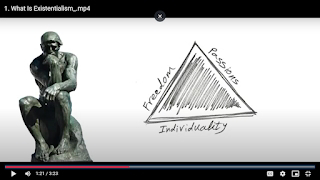
Video 1


In the first video I am impressed by this thought.

In our existence, individuality, passion, and freedom form the essential sides of life's triangle, shaping who we are and how we live.

Video 2

In the second video I am impressed by this thought.

The thought is about three belief. absence of hope, rejection , and conscious dissatisfaction all these three lead to philosophical death.

Video 3

In the third video I am impressed by this thought.


There are many ways of leaping. The essential being to leap.


Video 4

In the fourth video I am impressed by this thought.

Dadaism challenges what's important, while Existentialism helps you understand yourself better.


Video 5 

In the fifth video I am impressed by this thought.

Existentialism is response to emptiness. The absurd is rebelion for the time.


Video 6

In the Sixth video I am impressed by this thought.

I find it intriguing that there's no escape from life's absurdities while we're alive. According to Albert Camus's The Myth of Sisyphus, the only way to respond to these absurdities is through rebellion.


Video 7

In the seventh video I am impressed by this thought.

we need human perspective to look at human condition not divine perspective. 


Video 8

In the eighth video I am impressed by this thought.

They're talking about existential philosophy and Nietzsche's idea of Ubermacht, which is like a 'superman.' It means you have the power to shape your own life and give it meaning, just like Superman can do anything.


Video 9 

In the ninth video I am impressed by this thought.

I found Eric Dodson's insights in video 9 quite intriguing. He draws parallels between Existentialism and our daily experiences, emphasizing concepts like ideas, creativity, and sensitivity. Dodson highlights the importance of honesty, being direct, and having the freedom to decide in Existentialism, even when facing life's challenges. He views Existentialism as a mirror reflecting our true selves and an opportunity to act according to our personal values and beliefs.


Video 10

In the tenth video I am impressed by this thought.

Since there's no teleology, the world was not created for a reason, and it does not exist for a reason.


My Favorite Video Among All :


I found Video 7 quite engaging, especially the part where they delve into Existentialism. The discussion about its beginnings and key figures, particularly how the World Wars influenced it, was eye-opening. They tackle common existential questions like "Why am I here?" and explore various philosophical perspectives. The video also delves into the tension between religious beliefs and individuality in crafting one's purpose, even referencing Aristotle's thoughts. What really caught my attention was the clarification between Nihilism and Existentialism, and the explanation of Nietzsche's quote about nihilism being a disease and the idea of "becoming what you are." The video strongly emphasizes the central concept of Existentialism – that we have the power to shape our own subjective meaning.

Learning outcome -


This activity increased my understanding of Existentialism, especially with visuals, making concepts clearer. The videos covered diverse areas, providing deeper knowledge and connecting movements like Nihilism, Essentialism, and Dadaism. Overall, the flipped learning approach helped me grasp existential philosophy better.


Questions -


1. Can we say that Existentialism excludes the element 'Hope'? (In the context of Albert Camus' Philosophical Suicide)

2. In the video 'Existentialism for Five', we come to know about the question of existentialism is just simple- to make your own choice - Freedom - It really is?

3. In the video 'Existentialism for Five', we come to know that the question of existentialism is just simple- to make your own choice - Freedom - It only is?

4. What is the concept of 'Leap' in video no. 2?

5.In video 1 it is told that Existentialism attracted young people the most. So why only young? Can we say that these sort of existential quest rises only in young age?


Friday, February 23, 2024

The Great Gatsby by Francis Scott Fitzgerald


"The Great Gatsby" by F. Scott Fitzgerald


Introduction:

"The Great Gatsby" is a timeless tale delving into the extravagant Jazz Age, where love, money, and the pursuit of the American Dream collide amidst the lively Roaring Twenties. Following the enigmatic Jay Gatsby and his infatuation with the charming Daisy Buchanan, F. Scott Fitzgerald weaves a narrative rich in detail, vividly portraying both the allure and disillusionment of the era. If you're intrigued by stories of ambition, romance, and the consequences of relentless pursuit of wealth, this book is a must-read.


About the writer. 

F. Scott Fitzgerald, born in 1896, is a famous American writer known for his book "The Great Gatsby." He wrote about love, money, and the American Dream during the lively Jazz Age. His writing is full of details that show both the excitement and disappointment of that time. Fitzgerald's stories often talk about how society was changing and losing its values. His own life had ups and downs, similar to the stories he wrote. Even with his personal struggles, he's seen as one of the greatest American writers of the 1900s. People still love and learn from his stories today.


Notable Works :

1). "This Side of Paradise" (1920)
2). "The Beautiful and Damned" (1922)
3). "The Diamond as Big as the Ritz" (Novella) (1922)
4). "The Great Gatsby" (1925)
5) "Tender Is the Night" (1934)


Q-2) Creative and Analytical Activities:

(i) Modern Reimagining: Rewrite a key scene from the novel in a modern setting, considering how themes and character motivations might change.


Modern Setting:

   In today's city life, think of Gatsby's huge mansion as a fancy penthouse. It shows off success and cool stuff. The apartment is super fancy, with cool things inside and great views, telling the story of people trying to get rich and be popular in our time.

Character Change:
  
In a modern-day adaptation of "The Great Gatsby," envision Gatsby as a mysterious figure, now transformed into a prominent figure in the tech industry. No longer merely affluent, he emerges as a leader in the realm of technology. Instead of lavish gatherings in a historic mansion, his realm shifts to contemporary settings like chic penthouses or state-of-the-art event venues, serving as the backdrop to showcase his triumphs in the digital age. This updated portrayal seamlessly integrates Gatsby's enigmatic allure with the zeitgeist of our era, presenting a fresh take on his pursuit of success and influence.

Why Gatsby Does Things:
  
In the classic tale, Gatsby's desires centered on wealth and status to win Daisy's affection. In this contemporary retelling, Gatsby's ambitions take on a new dimension. He embodies the archetype of a visionary entrepreneur or inventor, driven not solely by financial gain but by a fervent desire to revolutionize the world with his technological innovations. His extravagant parties serve a dual purpose: not merely social gatherings, but strategic opportunities to forge connections with influential figures who can further his tech ventures. This modern interpretation captures the essence of Gatsby's quest for significance, portraying his journey as a quest to leave an indelible mark on the ever-evolving landscape of technology and innovation.

Daisy's Role:
  
 In the new "Great Gatsby," Daisy is like a famous person on Instagram. She's not just pretty; she's good at showing a fancy life online. People everywhere follow her posts, dreaming of living like her. Daisy makes money by posting ads and working with brands. Gatsby is crazy about Daisy because of her online life, but behind the perfect pictures, Daisy feels lonely and struggles to keep up appearances. This change shows how online life can be both glamorous and isolating, making us wonder about true relationships in a world crazy about social media.


ii) Symbolism Analysis: Identify and interpret key symbols in the novel, like the green light, the eyes of Doctor T.J. Eckleburg, and Gatsby's parties.

Green Light:


In "The Great Gatsby," that green light holds a deeper meaning. It's like a beacon of Gatsby's hopes and wishes, mainly his yearning for Daisy and a better tomorrow. This light symbolizes how what he longs for seems just beyond his grasp, sort of like chasing a dream that keeps slipping away. It's a powerful image of how Gatsby's desires reflect the broader American dream, which often feels distant and hard to attain.


Eyes of Doctor T.J. Eckleburg:

In "The Great Gatsby," those eyes of Doctor T.J. Eckleburg stand tall on a billboard, but they're more than just eyes. They're like a silent observer, keeping watch over everyone. Those eyes symbolize something bigger – the decay of morals in society. They're always there, reminding the characters of the choices they make and the not-so-perfect reality behind all the glitz and glamour. It's like a warning sign, showing that there's more to things than meets the eye, urging the characters to think twice about their actions.


The Valley of Ashes:

In "The Great Gatsby," the Valley of Ashes paints a vivid picture of contrast in America. On one hand, you've got the glitz, glamour, and riches – all bright and lively. But on the flip side, there's this grimy place, where the working folks dwell, amidst all the darkness. This sharp difference isn't just about scenery; it's about the people too. Take Daisy, Gatsby, and Jordan, for instance. They may seem all polished and perfect, but deep down, they're grappling with their own struggles and flaws, just like everyone else. The valley serves as a powerful reminder that appearances can be deceiving, revealing the hidden complexities within each character.


Parties:

Gatsby's extravagant parties symbolize the excessive and superficial lifestyle of the Jazz Age. They reveal the hollowness and superficiality of the wealthy elite, who use riches and material possessions to cover up their inner emptiness. The parties also emphasize the theme of illusion versus reality, as Gatsby constructs a grand facade to conceal his true identity and past.


iii) Historical Context Exploration: Research the historical and cultural context of the 1920s and analyze how it influences the plot, characters, and themes.


In "The Great Gatsby," the 1920s, known as the Roaring Twenties, played a big role. This era was all about change in America after World War I. It was a time of booming economy, new inventions, and shifts in how people lived and thought.

F. Scott Fitzgerald captures this vibe perfectly in the book. He shows us flashy parties, rich folks living it up, and this strong desire for success and wealth. Gatsby, the main character, represents this dream of making it big all on your own. He's all about the glitz and glamour, just like the 1920s were.

But there's another side too. Daisy, another key character, seems to have it all – money, status – but she's not happy. She symbolizes how sometimes, even with everything you could want, something feels missing. This shows the emptiness behind all the fancy stuff of the time.

The book digs into lots of big ideas too, like the gap between rich and poor, the changing values, and how people were obsessed with getting rich quick. Characters like Tom and Gatsby represent different sides of this – old money versus new money, tradition versus new ideas.

Overall, Fitzgerald uses this lively era as a backdrop to tell a story about society grappling with big changes, money, and the dream of success – themes that still resonate today.


iv) Comparative Analysis: Compare and contrast "The Great Gatsby" with another novel, film, or piece of art that explores similar themes.

When you look at books with similar themes, "The Great Gatsby" and J.D. Salinger's "The Catcher in the Rye" really stand out. They both dig deep into the American Dream, feeling let down, and trying to find what life's really about in a changing world.

In "The Great Gatsby," we're taken back to the flashy 1920s, where everyone's chasing money and happiness, but things aren't always what they seem. Meanwhile, "The Catcher in the Rye" brings us to the post-World War II era, focusing on a young guy named Holden Caulfield. He's struggling with feeling like he doesn't fit in and seeing through all the fake stuff around him.

These books both hit on big ideas like figuring out who you are, being true to yourself, and finding meaning when everything feels shallow. Gatsby tries to hold onto a past he can't quite reach through Daisy, while Holden rebels against a world he sees as phony, wanting real connections and truths.

By looking at these two books together, we get a deeper understanding of how people have always grappled with feeling lost, searching for something real, no matter the time or place.


Thank you...

Saturday, February 17, 2024

Vita and Virginia 2018 Movie


Hello readers,


                                                       Vita & Virginia (Movie Screening Review)


"Vita & Virginia" isn't just a regular movie; it digs deep into how people connect and how those connections affect us. Director Chanya Button skillfully shows us important moments in Vita & Virginia's lives that shaped who they were. It's not just about facts; it's about really understanding these two writers and their special friendship.

Button helps us see the ups and downs of their lives, showing us their feelings and how close they were. "Vita & Virginia" is praised for showing the ups and downs of relationships, teaching us about acceptance, handling emotions, and making our own choices.

It's more than just a movie; it's like a journey that helps us understand how relationships work and why they matter.

(Q&A)

1). Who do you think is initiating the relationship, Vita or Virginia? Who do you think is taking advantage of this relationship? 

Figuring out who started the relationship between Vita and Virginia is like trying to know who began a chat – it's not always clear. Both Vita and Virginia played a part in making their bond special. It's like a dance where both people shape how it goes.

Saying one of them is to blame is too simple. Relationships are like colorful paintings, not just black and white. We should understand their connection better before blaming anyone. It's like a puzzle where both of them influenced each other.

2). Who do you think is confused about their identity Vita or Virginia? Explain with illustrations.

Deciding who was more unsure about themselves, Vita or Virginia, is tricky because they both had times when they didn't know who they were. 

Vita had to figure out what she wanted to be in a world that had strict rules for women. She tried different roles, like being a wife and a writer, to find her place.

Virginia struggled with her feelings and thoughts, which made it hard for her to understand herself. Her identity kept changing because of the challenges she faced, and she used writing to make sense of it all.

In simple words, both Vita and Virginia had their own journeys to find themselves, so it's hard to say who was more confused. It's like comparing two stories that are still being written.

3). What is society’s thought about women and identity? Do you agree with them? If Yes then why? If no then why?

When we talk about society, it often feels like we have to give up our own ideas and choices. Society comes with various rules, restrictions, and judgments, especially for women. Women often face people's opinions and strict rules, like following traditions, limited clothing choices, and being confined to specific roles at home.

Unfortunately, society doesn't always welcome the progress and desires of women. There's a noticeable divide between what women want and what society expects. Women deserve support and respect, and I strongly disagree with beliefs that limit them. Women are a vital part of our world, and in our culture, we consider them as symbols of goddesses. They have their own place, life, choices, and thoughts, and it's essential to appreciate and respect that.


4). Write a note on your observations of the society during that era.

In the old days, women had to follow lots of rules, especially at home. They had to stick to certain traditions, wear limited types of clothes, and stay in specific roles. If women talked about having big dreams or making progress, it wasn't always accepted. There was this big gap between what women wanted and what society thought they should want.

It felt like society didn't want women to do their own thing. Even though women were really important, there was this difference between what they wanted and what society said they should want.

But it's important to challenge these old ideas. Women weren't just symbols; they were real people with their own lives, choices, and thoughts. When we look back, we can see that we need to break these old rules, appreciate differences, and make a world where everyone's contributions matter and are respected.


5). Write a note on the direction of the movie. Which symbols and space caught your attention while watching the movie?

In "Vita & Virginia," the director, Chanya Button, beautifully captures the deep complexities of Vita Sackville-West and Virginia Woolf's relationship. Button skillfully incorporates symbolic elements such as the frozen Thames River, representing the coldness and distance between the characters, and the exchange of letters, symbolizing their emotional connection. 

The movie particularly shines in its portrayal of the intimate moments through the letter-writing scenes. When Virginia pens her thoughts and feelings to Vita, the depth of their love and connection is vividly portrayed.

Moreover, the film pays attention to details like the garden settings, the interiors of their homes, and Virginia's bedroom, adding layers to the narrative and enriching the visual experience. Through these elements, the director captures the essence of their relationship and the world they inhabited, making "Vita & Virginia" a compelling exploration of love, desire, and creativity.

Symbols like flowers and gardens seemed to carry significant meaning, portraying growth, change, and the delicate yet resilient nature of relationships. These symbols, woven into the storyline, provided a visual language that enhanced the emotional impact of the movie.


6). "Vita and Virginia" had to be made into a Bollywood Adaptation, who do you think would be fit for the role of Vita and Virginia?

For a Bollywood adaptation of "Vita and Virginia," considering the charm and acting prowess needed for the roles of Vita and Virginia, I could envision Taapsee Pannu portraying the spirited Vita Sackville-West. Her versatility and ability to bring depth to characters make her a strong fit.


As for the role of Virginia Woolf, an actress like Kangana Ranaut could bring the required intensity and depth to capture Virginia's complexities. Kangana's nuanced performances align well with the intricate emotional layers associated with the character.


Thank you...

Sunday, February 11, 2024

The Waste Land - Thinking Activity


Thinking Activity - The Waste Land


Hello Readers,


This blog is based on Thinking activity. Assigned by Dr. Dilip Barad sir. In this Blog you can find out some questions and answers about T.S. Eliot's Poem 'The Waste Land'.


The Waste Land : 


T.S. Eliot's "The Waste Land," published in 1922, stands as a seminal work in modernist poetry, challenging traditional notions of unity with its esoteric complexity and fragmented structure. Divided into five sections, each segment delves into the unraveling of modern societies:

1. The Burial of the Dead: Here, Eliot symbolizes spiritual decay in a desolate wasteland, where inhabitants cling to their mundane routines, resisting any semblance of spiritual renewal. Even the typically rejuvenating month of April takes on a cruel tone, reflecting the inhabitants' rejection of spiritual rebirth.

2. A Game of Chess: Drawing inspiration from Middleton's play, Eliot depicts a society where love deteriorates into base desire. The allusion to Philomel represents the potential for purification through suffering, yet in the modern context, any hope for regeneration seems lost.

3. The Fire Sermon: Named after Buddha's sermon, this section highlights the spiritual decline of the world, consumed by a raging inferno of hatred and desire.

4. Death by Water: Water serves as a symbol of purification and renewal, but Phlebas's demise signifies the fate of those consumed by worldly pursuits, their youth extinguished by mortality.

5. What the Thunder Said: This section suggests liberation from spiritual desolation, drawing parallels with the Fisher King myth's knightly quest and Christ's disciples' journey to Emmaus, symbolizing the pursuit of truth and resurrection.

In essence, "The Waste Land" delves into themes of fragmentation, loss, sexual depravity, and spiritual decay, offering a profound exploration of the human condition amidst societal disintegration. Eliot's innovative style reshaped 20th-century English literature, leaving an indelible mark on poetic aesthetics.


1) What are your views on the following image after reading 'The Waste Land'? Do you think that Eliot is regressive as compared to Nietzsche’s views? or Has Eliot achieved universality of thought by recalling mytho-historical answer to the contemporary malaise?


T.S. Eliot's "The Waste Land" and Nietzsche's concept of the Übermensch represent distinct philosophical perspectives, but understanding how Eliot's work relates to Nietzsche's ideas requires a nuanced examination.

Nietzsche's Übermensch concept advocates for the individual's transcendence of traditional values and the creation of their own meaning and morality. This idea emphasizes the importance of personal agency and the rejection of societal norms and constraints. In contrast, Eliot's "The Waste Land" often draws on established mythological, religious, and cultural frameworks to explore contemporary issues.

Eliot's use of myth and history in "The Waste Land" can be seen as a departure from Nietzsche's emphasis on individual autonomy. Instead of advocating for the creation of new values, Eliot looks to the past for insights into the present. By invoking ancient myths and historical references, Eliot seeks to transcend the limitations of his contemporary society and provide a broader, more enduring perspective on themes such as spiritual decay, disillusionment, and the search for redemption.

However, this reliance on tradition does not necessarily render Eliot's approach regressive. Rather, it can be viewed as a deliberate attempt to achieve universality of thought. By tapping into mytho-historical narratives, Eliot offers a framework for understanding contemporary malaise within a broader, transcendent context. This allows his work to resonate with readers across different contexts and time periods, contributing to its enduring relevance and significance.

In essence, while Eliot's approach may differ from Nietzsche's concept of the Übermensch, it is not inherently regressive. Instead, it represents a nuanced exploration of timeless human experiences and truths, achieved through the recall of mytho-historical narratives to address contemporary concerns.


2) Prior to the speech, Gustaf Hellström of the Swedish Academy made these remarks:


What are your views regarding these comments? Is it true that giving free vent to the repressed 'primitive instinct' lead us to happy and satisfied life? or do you agree with Eliot's view that 'salvation of man lies in the preservation of the cultural tradition'?


In his essay "For Lancelot Andrews," Eliot hailed him as a classicist in literature, a royalist in politics, and Anglo-Catholic in religion. Given Eliot's classical and Catholic background, he adheres to traditional views on salvation. However, the concept of salvation is inherently perplexing. In contrast, Freud argued that embracing repressed 'primitive instincts' leads to a fulfilling life, rendering the pursuit of salvation irrelevant.

The notion of 'salvation,' often intertwined with religion, implies living a simplistic life devoid of desires. Some religious doctrines emphasize stringent rules, fasting, and rituals for salvation, fostering the emergence of leaders with their own mandates. This can confine individuals, compelling them to blindly adhere to narrow guidelines.

Salvation functions akin to a 'super ego,' prompting individuals to conform to societal norms. In 'The Uneasiness in Civilization,' Freud discusses the need to balance primitive desires (id) with societal expectations (superego). Freudian perspectives were influential during that era, delving into the deeper and darker facets of the human psyche. Without restrictions on the pursuit of human pleasure, the consequences could be disastrous.

Eliot, however, opposes this view, finding salvation in the preservation of cultural traditions. He contends that tradition serves to maintain order and grounds individuals in a specific cultural heritage, a notion of enduring value from a modern perspective. Eliot's concept of salvation revolves around culture, which evolves over time and shapes human behavior, offering a pathway to happiness.


3) Write about allusions to the Indian thoughts in 'The Waste Land'. (Where, How and Why are the Indian thoughts referred?


"The Waste Land" by T.S. Eliot contains several allusions to Indian thoughts, particularly through references to Hindu scripture and philosophy. One prominent example is in the section "The Fire Sermon," where Eliot references the Bhagavad Gita, a sacred Hindu text, with the line: "Datta. Dayadhvam. Damyata." These Sanskrit words roughly translate to "Give, sympathize, control," reflecting themes of charity, compassion, and self-restraint found in Hindu teachings.

Additionally, in the same section, there are references to the Upanishads, ancient Hindu texts exploring philosophical concepts such as karma and rebirth. Eliot incorporates these ideas to underscore themes of spiritual desolation and the search for redemption amidst a fragmented modern world.

The river Thames in "The Waste Land" is often compared to other mythic rivers, including the Ganges. This comparison suggests a connection between the pollution and decay of modern civilization depicted in the poem and the spiritual cleansing associated with rivers in Hinduism.

Throughout the poem, Eliot incorporates snippets of Sanskrit chants, such as "Shantih shantih shantih," which translates to "Peace, peace, peace." This repetition of Sanskrit phrases adds a mystical and transcendent quality to the text, evoking the spiritual traditions of India and hinting at the possibility of transcendence amidst the desolation depicted in the poem.

The inclusion of Indian thoughts in "The Waste Land" serves to enrich the poem's exploration of cultural and spiritual decay, as well as to suggest alternative perspectives on existence and meaning beyond Western tradition. Eliot's use of these allusions highlights his interest in drawing from diverse cultural and religious sources to capture the complexity of the human experience.


Is it possible to read 'The Waste Land' as a Pandemic Poem?


Yes, it's possible to interpret T.S. Eliot's "The Waste Land" through the lens of a pandemic poem. 

"The Waste Land" by T.S. Eliot can be seen as a poem that reflects the feelings of chaos, confusion, and despair that people may experience during a pandemic. Just like how the world can feel broken and fragmented during such times, the poem portrays a world that is disordered and lacking in coherence. The imagery of barren landscapes and empty streets in the poem can resonate with the sense of isolation and desolation that many may feel during a pandemic. 

Additionally, The poem's themes of disillusionment, fragmentation, and the search for meaning in a chaotic world can resonate with the experiences of individuals during times of crisis, such as a pandemic. Moreover, the poem's exploration of themes such as death, rebirth, and the search for meaning amidst destruction can parallel the existential questions that arise during times of crisis. 

Overall, while "The Waste Land" wasn't written specifically about a pandemic, its themes and imagery can certainly be interpreted through the lens of such an event, offering insights into the human experience during times of profound uncertainty and upheaval.


Thank you... 


Assignment: 208: Comparative Literature & Translation Studies

  Reimagining Literary History Through a Translating Consciousness: A Critical Reading of G. N. Devy’s “Translation and Literary History: An...